
From JFK Security to the Negev: A Day in Israel
I’m standing in line for my security check before boarding our flight at JFK, and I find myself having a rather unexpected reaction: I LOVE all this security. Bring it on. The questions, the scrutiny, the checks. Plungers and all.
The two Israeli women conducting our screening are women I am quite certain have more martial arts skills, security know-how, and general ability to take charge than anyone else I know. And I am absolutely thrilled that they are here. Ask me as many questions as you want. Check whatever you need to check. I am happy to cooperate.
There is also a man in our line who clearly needs to wait his turn but has decided that waiting his turn is not really for him. He quickly discovers that these two women are not having it. One of them firmly directs him to the back of the line. No discussion. No negotiation. He is definitely not in charge. Hashem may be in charge of the universe, but this Israeli woman is most definitely in charge of this security line.
And apparently, it is time for prayer. A group of men has gathered, although I am not entirely sure which prayer it is time for or why they have chosen the ATM as their focal point. I will reserve all the stereotype jokes that are coming to mind. Some observations are better left to the imagination.

Fast forward to Israel.
We are heading south, taking Route 6, the Trans-Israel Highway, which runs through much of the country and connects north and south. This week, November 4, marks the yahrzeit of Yitzhak Rabin, the Israeli prime minister who was assassinated in 1995. His murder remains one of the most consequential and painful moments in modern Israeli history. It is hard not to think about the complexity of this country as we travel through it: its extraordinary accomplishments, its internal divisions, its security concerns, and its ongoing struggles over what kind of country it wants to be.
Our destination is Beer Sheva, a place many of you may recognize from the Torah reading on Rosh Hashanah morning: the Akedah, the binding of Isaac. After Abraham nearly sacrifices his son and the angel intervenes, Abraham returns to his young men, and they travel together to Beer Sheva. The Torah tells us that Abraham settled there. So here we are, traveling to a place that is woven into one of the most emotionally complicated stories in the entire Torah. Not exactly light vacation reading!
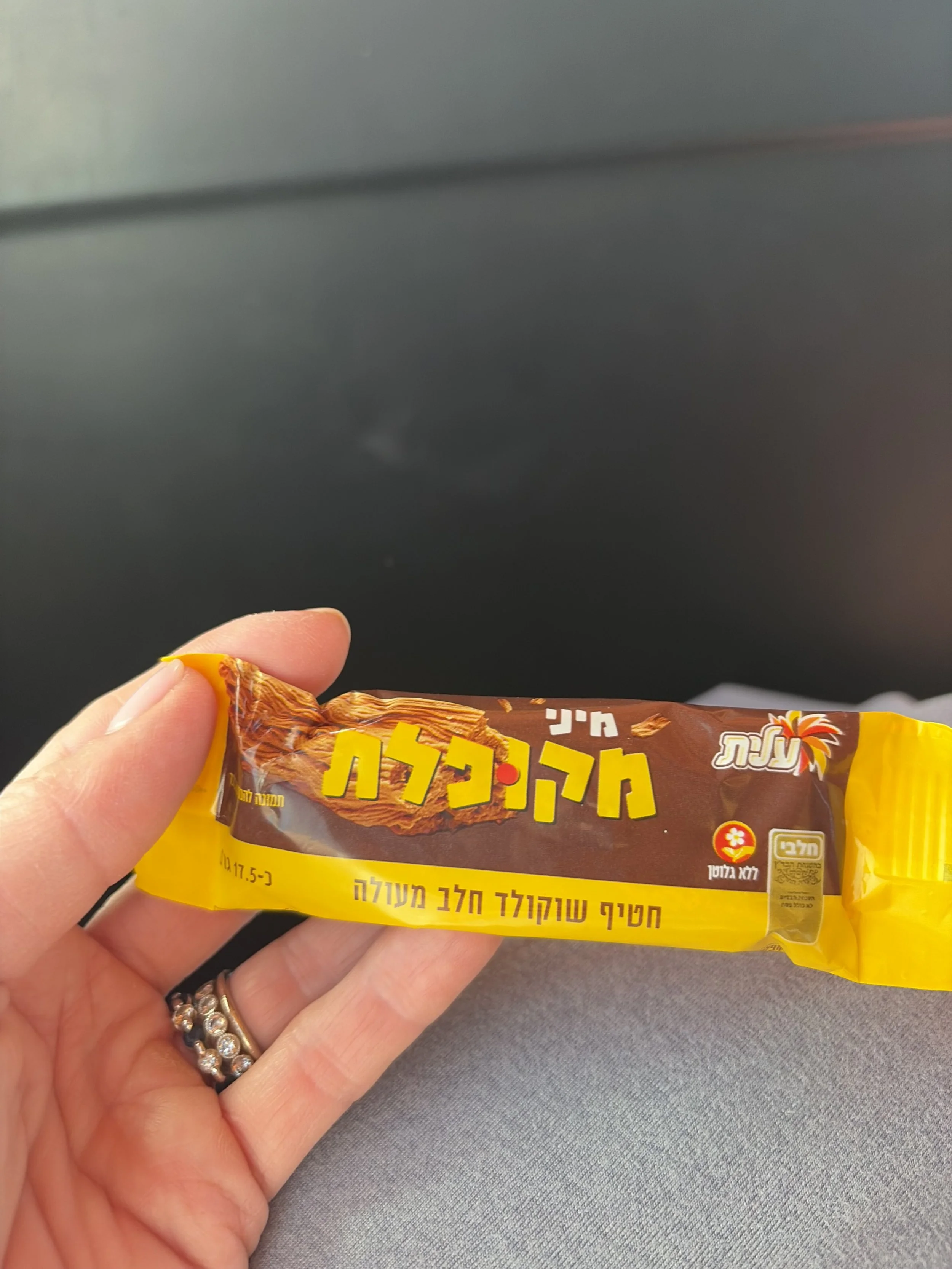
It might be 8:30 in the morning in Israel, but it is never too early for Elite chocolate. Especially the crumbly bar. Some things require no explanation, and some things are simply part of the Israeli experience.
As we travel, we notice yellow signs still posted after the recent election. They read: "Absolute Failure: Iran, Gaza, Lebanon."
These are anti-Netanyahu political protest signs, expressing the frustration of Israelis who believe the government's handling of the country's security challenges and its multiple military fronts has been a failure. The signs are a reminder that Israelis are not simply spectators to the decisions being made in Jerusalem. They are vocal, engaged, passionate, and often deeply divided about their country's leadership and direction.
I find myself struck by the fact that even amid all the security concerns and the ongoing challenges, the political conversation is everywhere. Israelis are not shy about making their opinions known. They argue, protest, criticize, and debate. That, too, is part of the complicated, noisy, sometimes exhausting, and very much alive reality of Israeli democracy.
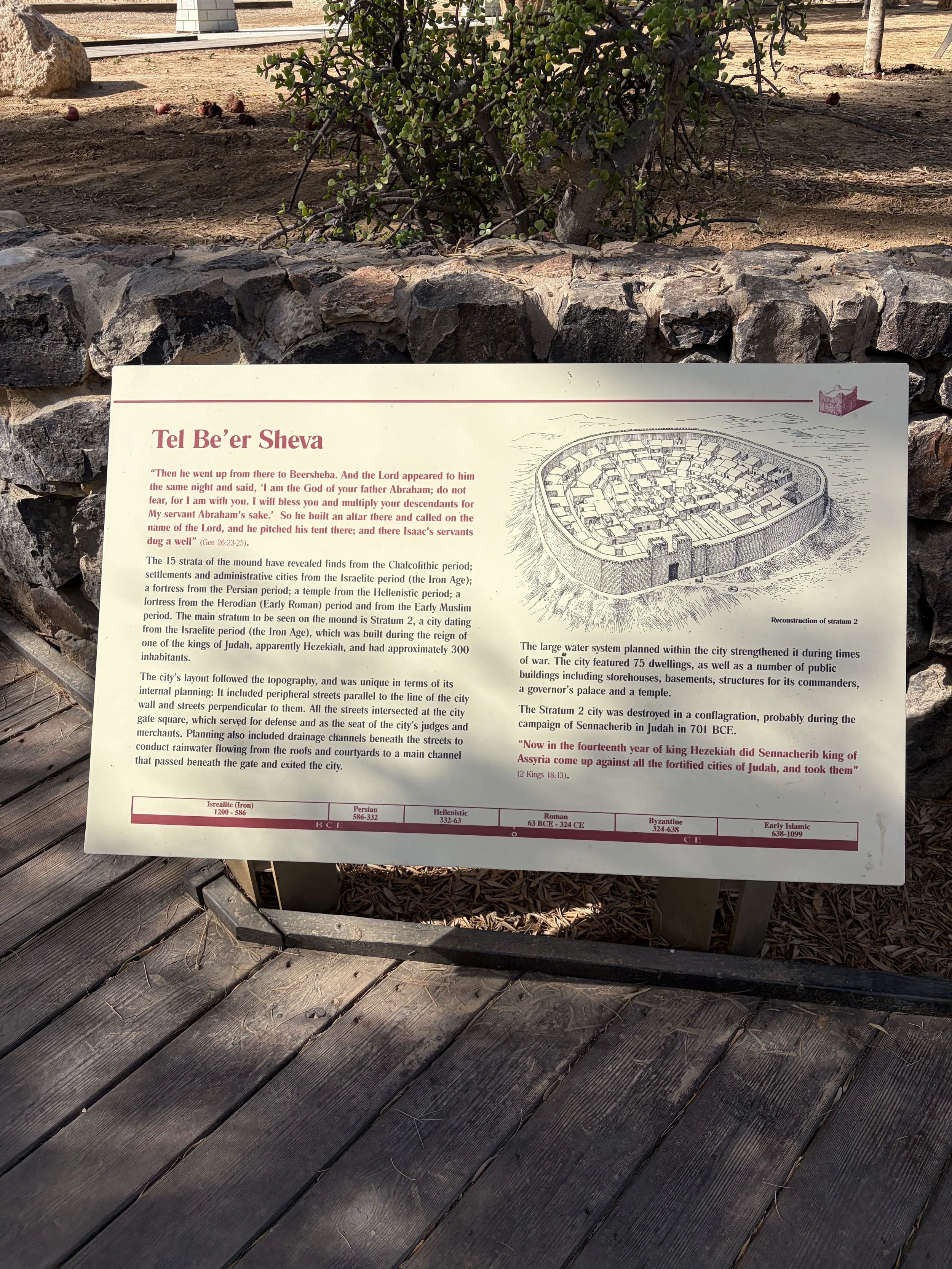
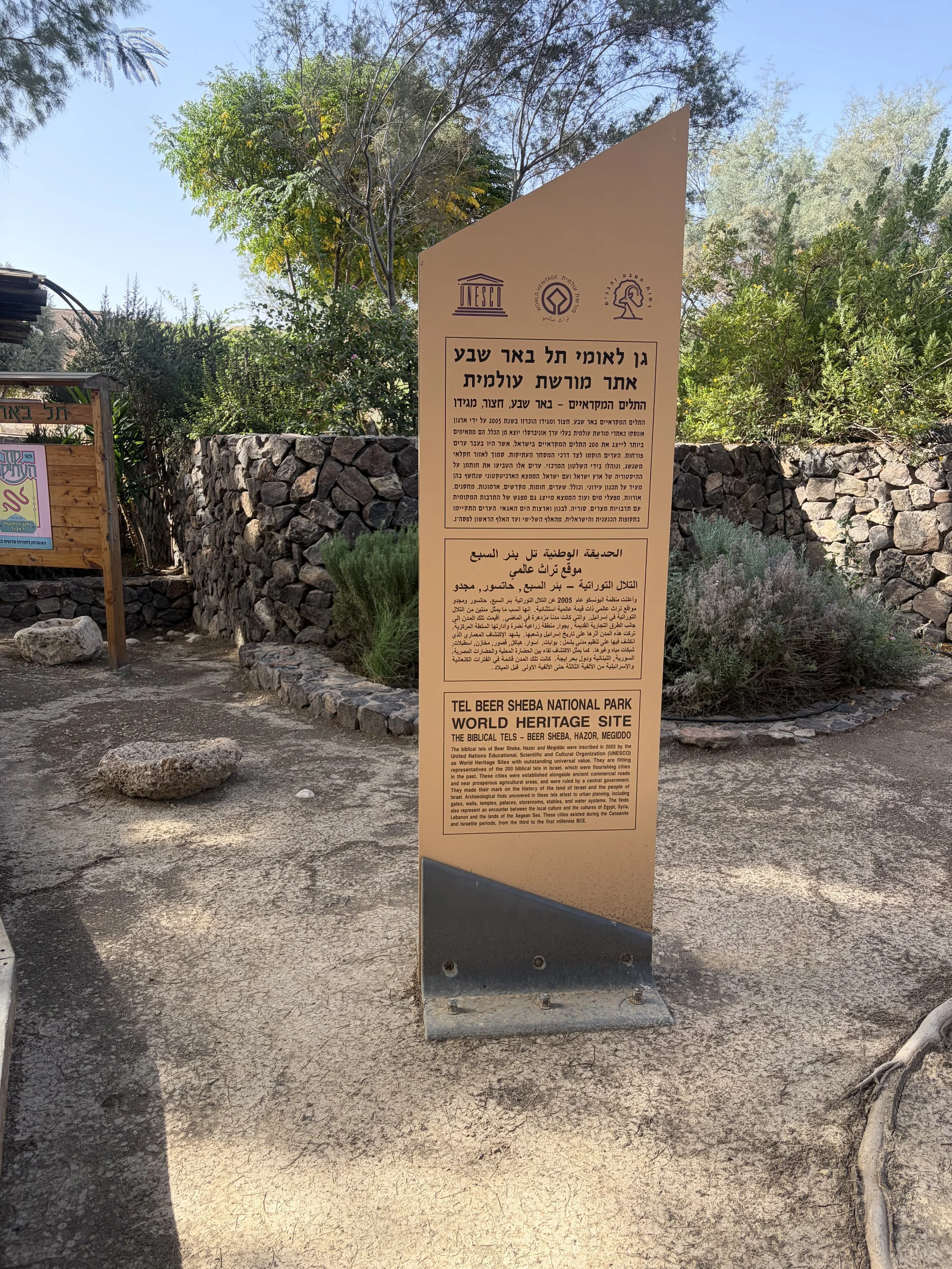
Our first major stop is Tel Beer Sheva, an extraordinary archaeological site that brings together the world of the Bible and the world of ancient Israel.
A tel is an artificial mound created over centuries as one settlement is built on top of another. People lived in the same location, rebuilt their homes, repaired their walls, and constructed new cities over the remains of earlier ones. Over time, the accumulated layers of human civilization create a hill. Archaeologists excavate those layers to uncover the lives of the people who came before us.
Tel Beer Sheva preserves the remains of an ancient Israelite city, with its principal remains dating to the Iron Age, particularly the 8th century BCE, and evidence of earlier settlement reaching back to the 10th century BCE. The city was carefully planned, with a distinctive gate, administrative buildings, storage facilities, residential neighborhoods, and an impressive defensive wall.
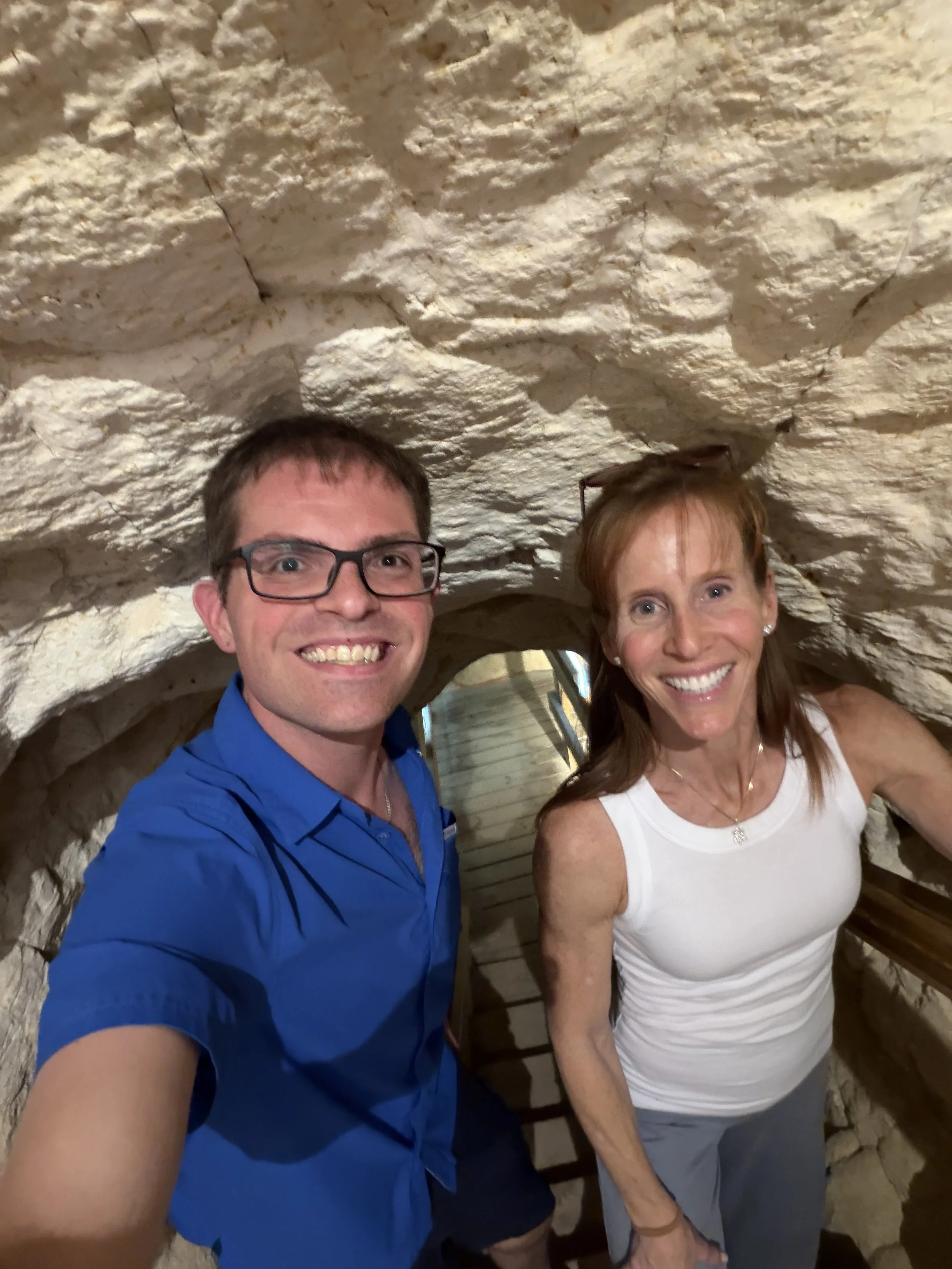
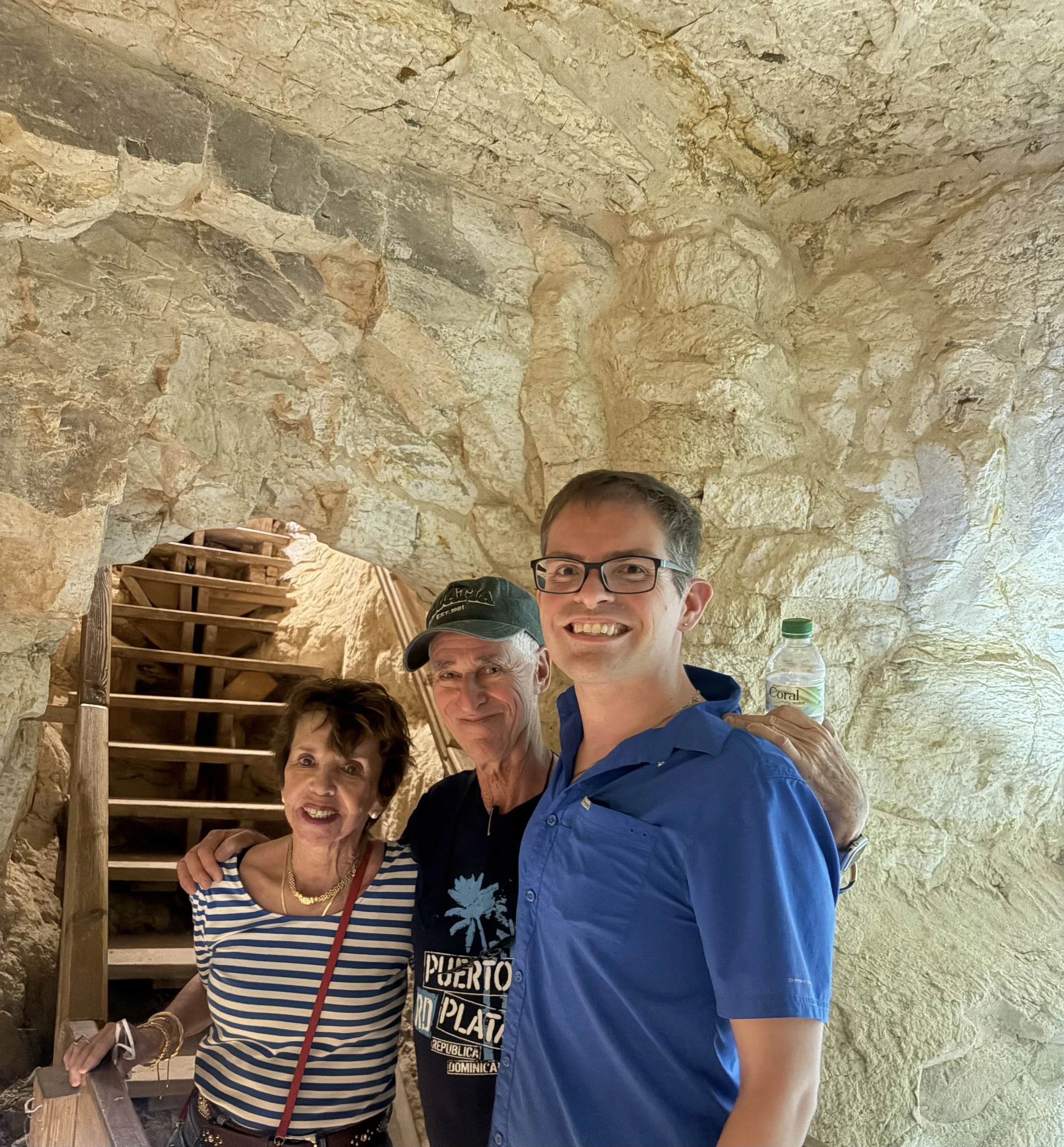
One of the most fascinating features is the ancient water system. In this arid part of the country, water was everything. The inhabitants developed an elaborate system to collect and store rainwater, including a huge underground reservoir reached by a staircase. Imagine living in a city where your ability to survive depended on engineering, planning, and making every drop count. Suddenly, our modern obsession with water conservation doesn't seem so new.
The city also gives us a glimpse into everyday Israelite life. The four-room house, a characteristic form of ancient Israelite domestic architecture, tells us about how families organized their living spaces, stored their food and belongings, and went about their daily lives. These weren't just biblical characters. They were people with homes, families, responsibilities, and the same basic needs we have today.
Tel Beer Sheva is one of three biblical tels recognized as a UNESCO World Heritage Site, along with Megiddo and Hazor. Standing here, it is remarkable to think that the names we encounter in the Torah and the historical books of the Bible refer to actual places, communities, and civilizations whose remains we can still walk through.
We also visit the modest home of David Ben-Gurion at Kibbutz Sde Boker in the Negev.
Ben-Gurion, Israel's first prime minister and the man who declared the establishment of the State of Israel in 1948, made a rather remarkable decision in 1953. He stepped away from the prime ministership and moved with his wife, Paula, to a small kibbutz in the middle of the desert. He believed that the future of Israel depended on developing the Negev, and he wanted to lead by example. His famous vision was to make the desert bloom.
Think about that for a moment. The leader of a young country, facing enormous challenges, chooses to move away from the political center of the country and settle in the desert. He wanted young Israelis to see that the Negev wasn't the edge of the country or an empty expanse to be crossed on the way somewhere else. It was central to Israel's future.
The house itself is wonderfully modest. It has been preserved just as it was when Ben-Gurion died in 1973, in accordance with his wishes. His study and library are particularly fascinating. There are approximately 5,000 books, covering everything from Jewish texts and the Bible to philosophy, history, geography, and military affairs. The books tell you something about the man: a leader who was intensely curious, deeply intellectual, and constantly thinking about the future.
Walking through his home, I was struck by the contrast between the enormity of the decisions he made and the simplicity of his surroundings. There is something powerful about seeing the personal space of someone who helped create a country.
And perhaps that is the larger theme of the day. Israel is a place where the ancient and modern are never very far apart. We can stand in a city that Abraham knew, walk through the remains of an ancient Israelite community, and then visit the home of the man who helped bring the modern State of Israel into existence.
Thousands of years of Jewish history, all in one day. And, of course, a little Elite chocolate along the way.
Not a bad day in Israel.
Tomorrow we will spend the day in the Gaza envelope, immersing ourselves in the aftermath of the October 7th brutal attack on Israel. Now... we sleep!